I was looking at the Webflow Analyze report of top pages on the OpenSSL Foundation webpage and noticed we have a lot of 404s:
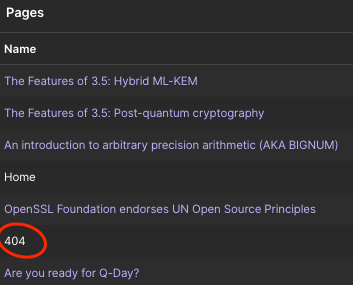
A 404 means someone arrived via a broken or missing URL. Often the problem comes when a site is redesigned and the structure has changed. Since we launched a new site at the start of the year, it pays to investigate. Unfortunately I couldn’t figure out how to do that with Webflow’s tools. Thankfully, Google Search Console registers 404 pages and shows the URL that was used:
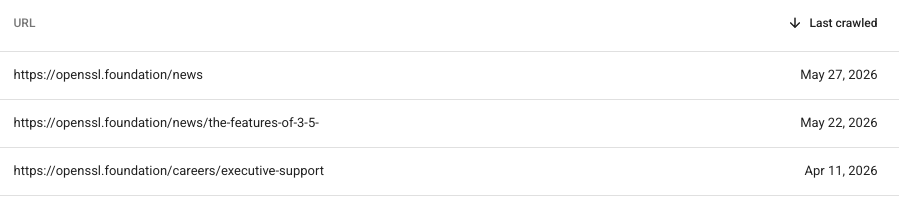
The first URL comes from changing the site design. It’s rather easy to fix with a redirect:
/news —> /insights/insights
Looking at it now, it’s an odd URL structure. That might be something to look at in the future, but for now the redirect gets people to where they probably wanted to go.
The last item is a job listing that doesn’t exist anymore because we hired Michelle Mooney. A 404 is appropriate for this one because that page is no longer available on the site on purpose.
But what about https://openssl.foundation/news/the-features-of-3-5-? Where did that come from? Well, clicking on the item in Search Console, I got this report:
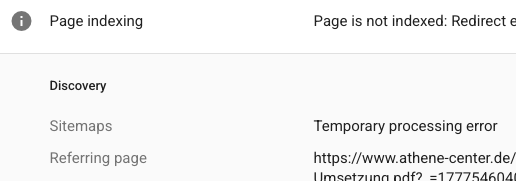
So the one referring page is from “Post-Quanten-Kryptografie in Umsetzung”, a publication from a research institute in Darmstadt, Germany. In the references, the Foundation’s blog is listed:
![[14] OpenSSL Foundation, „The Features of 3.5: Post-quantum cryptography,“ April 2025. [Online]. Verfügbar unter: https://openssl.foundation/news/the-features-of-3-5- post-quantum-cryptography. [Zugriff am 31. Januar 2026].](https://meta.jlericson.com/uploads/jlericson/original/1X/7ff60ceb92d9d531f0aabb36bffdf9836e8354f4.png)
Hopefully you see the problem. The hyphen was used to wrap the URL. The page that should have been referenced was https://openssl.foundation/news/the-features-of-3-5-post-quantum-cryptography. Again, it’s easy enough to fix with a redirect.
As an aside, I think this might be the first time my writing was used in a citation. The text it backed up was:
Auch aktuelle Versionen von TLS-Bibliotheken wie OpenSSL unterstützen bereits PQC-Verfahren [14].
Or, according to Google Translate:
Current versions of TLS libraries such as OpenSSL also already support PQC methods [14].
I can confirm!
Those changes have helped reduce the number of 404s that we are getting. It’s something I will continue to check from time to time.