I guess I always knew the Declaration of Independence must have gone through a few drafts before it was approved by the Second Continental Congress on July 4, 1776. But I didn’t know what was left out until I read Jefferson’s “original Rough draught”. The big omission is:
[King George III] has waged cruel war against human nature itself, violating it’s most sacred rights of life & liberty in the persons of a distant people who never offended him, captivating & carrying them into slavery in another hemisphere, or to incur miserable death in their transportation thither. this piratical warfare, the opprobrium of infidel powers, is the warfare of the CHRISTIAN king of Great Britain. determined to keep open a market where MEN should be bought & sold, he has prostituted his negative for suppressing every legislative attempt to prohibit or to restrain this execrable commerce: and that this assemblage of horrors might want no fact of distinguished die, he is now exciting those very people to rise in arms among us, and to purchase that liberty of which he has deprived them, & murdering the people upon whom he also obtruded them; thus paying off former crimes committed against the liberties of one people, with crimes which he urges them to commit against the lives of another.
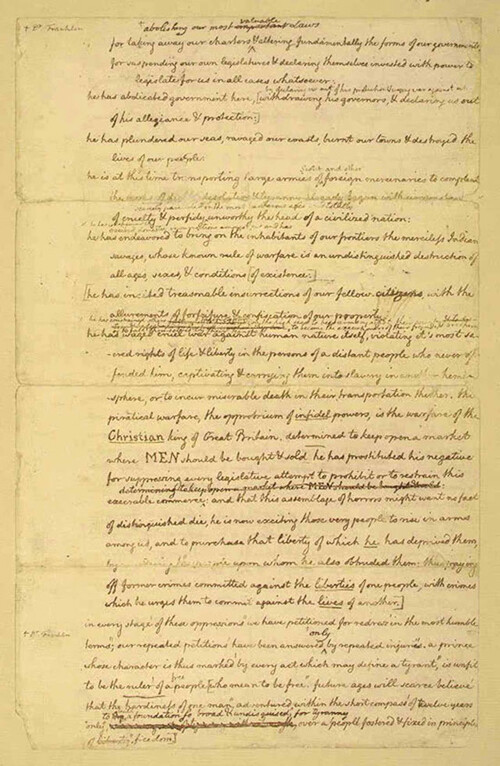
In this section, Jefferson directly confronts the contradiction of the slave trade, which deprives slaves of their liberty, with the ideals laid out in the declaration that “All men are created equal, that they are endowed by their Creator with certain unalienable Rights, that among these are Life, Liberty and the pursuit of Happiness.” Think of how much trouble we could have saved ourselves if this paragraph had been left in and the paragraph about “Indian savages” had been removed:
He has endeavored to bring on the inhabitants of our frontiers the merciless Indian savages, whose known rule of warfare is an undistinguished destruction of all ages, sexes, & conditions of existence.
This complaint was likely more salient to the men fighting for independence as the British Indian Department would employ parts of the Iroquois Confederacy to raid frontier settlements. There had been slave rebellions in the colonies too and the final wording of the Declaration obliquely alludes to that possibility (“domestic insurrections”) in the the edited “Indian savages” clause:
He has excited domestic insurrections amongst us, and has endeavoured to bring on the inhabitants of our frontiers, the merciless Indian Savages whose known rule of warfare, is an undistinguished destruction of all ages, sexes and conditions.
Knowing how the story of the United States preceded, we sometimes get fooled into thinking that a handful of white men decided the fate of African slaves and Native Americans from their comfortable seats in Philadelphia. And while the signers were white men (mostly English), they weren’t particularly comfortable. Here’s how Jefferson ended the Declaration:
And for the support of this declaration we mutually pledge to each other our lives, our fortunes, & our sacred honour.
These weren’t hollow words. Some of the signers lost their property to British forces and some were captured in the Siege of Charlestown. There is little doubt that if the Revolution had failed, many would have been executed or left to rot in English prisons. As Benjamin Rush wrote to John Adams years later:
Do you recollect your memorable speech upon the Day on which the Vote was taken? Do you recollect the pensive and awful silence which pervaded the house when we were called up, one after another, to the table of the President of Congress, to subscribe what was believed by many at that time to be our own death warrants? The Silence & the gloom of the morning were interrupted I well recollect only for a moment by Col: Harrison of Virginia who said to Mr Gerry at the table, “I shall have a great advantage over you Mr: Gerry when we are all hung for what we are now doing. From the size and weight of my body I shall die in a few minutes, but from the lightness of your body you will dance in the air an hour or two before you are dead.” This Speech procured a transient smile, but it was soon succeeded by the Solemnity with which the whole business was conducted.
While we might wish our Founders had made a stronger stand for the ideals we now share, we must not forget they moved closer and set the stage for who we are. And we must remain humble that our greatest ideals may similarly fall short in the judgment of our futures.